LinkedIn Designing LinkedIn Mentorship Experience

This was a one-week design challenge where I created a “Mentoring” module for LinkedIn’s desktop platform. It helps mentors and mentees discover each other, connect meaningfully, and schedule mentoring sessions aligned with their professional goals.

Timeline

Mar 2025 (7 Days)

Timeline

Mar 2025 (7 Days)

Timeline

Mar 2025 (7 Days)

Team

Individual

Team

Individual

Team

Individual

Contributions

User Research, Stakeholder Interviews, Design Iteration & Prototyping

Contributions

User Research, Stakeholder Interviews, Design Iteration & Prototyping

Contributions

User Research, Stakeholder Interviews, Design Iteration & Prototyping

Project Type

Design Challenge

Project Type

Design Challenge

Project Type

Design Challenge

Design Brief

LinkedIn has decided to add a new module called “Mentoring” to its platform. This module aims to enable mentors and mentees to discover each other, connect meaningfully, and schedule mentoring sessions that align with their professional goals.

Research

Understanding the problems through interviews with mentors and mentees

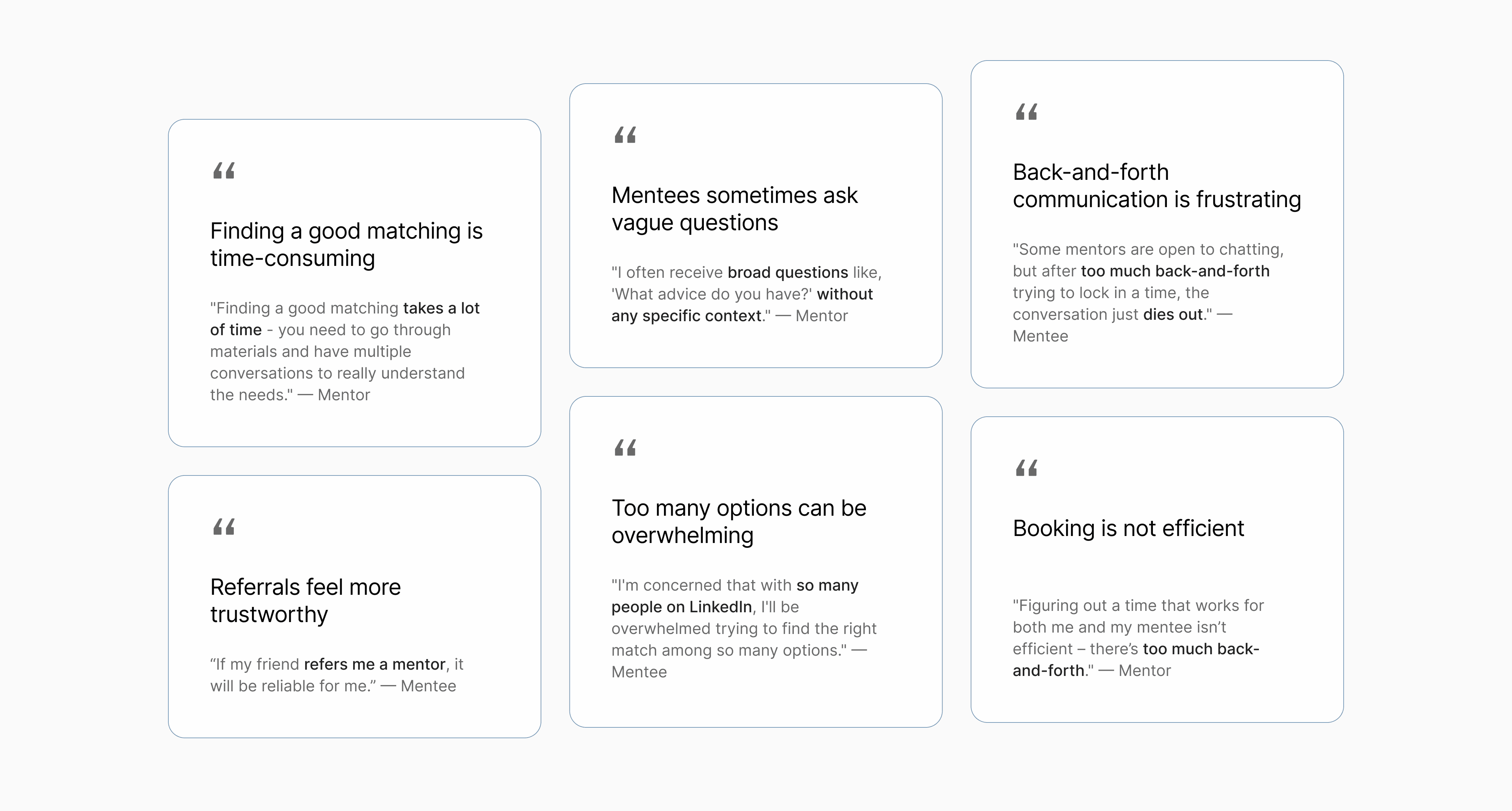
To understand the problem, I conducted 30-minute semi-structured user interviews with 3 mentors and 3 mentees to identify their pain points regarding mentorship. In the interviews, I asked about their experiences across three key scenarios: discovering, connecting, and scheduling.
Refine the Scope

Focusing on long-term mentorship for deeper value and business potential

From the interview, I identified two mentorship models. Given my limited time, I decided to focus on long-term mentorship because: 1) It needs stronger compatibility and a larger mentor pool—something LinkedIn’s vast user base supports, and 2) It opens monetization opportunities through service fees and Premium subscriptions.

☕️

Coffee Chat

  • Free, short, informal one-time conversation

  • Low commitment

  • Less structured; more casual

🤝

Long-term mentorship (Focus)

  • Paid, ongoing relationship

  • Higher commitment

  • Structured with goal setting, feedback loops

Target Users

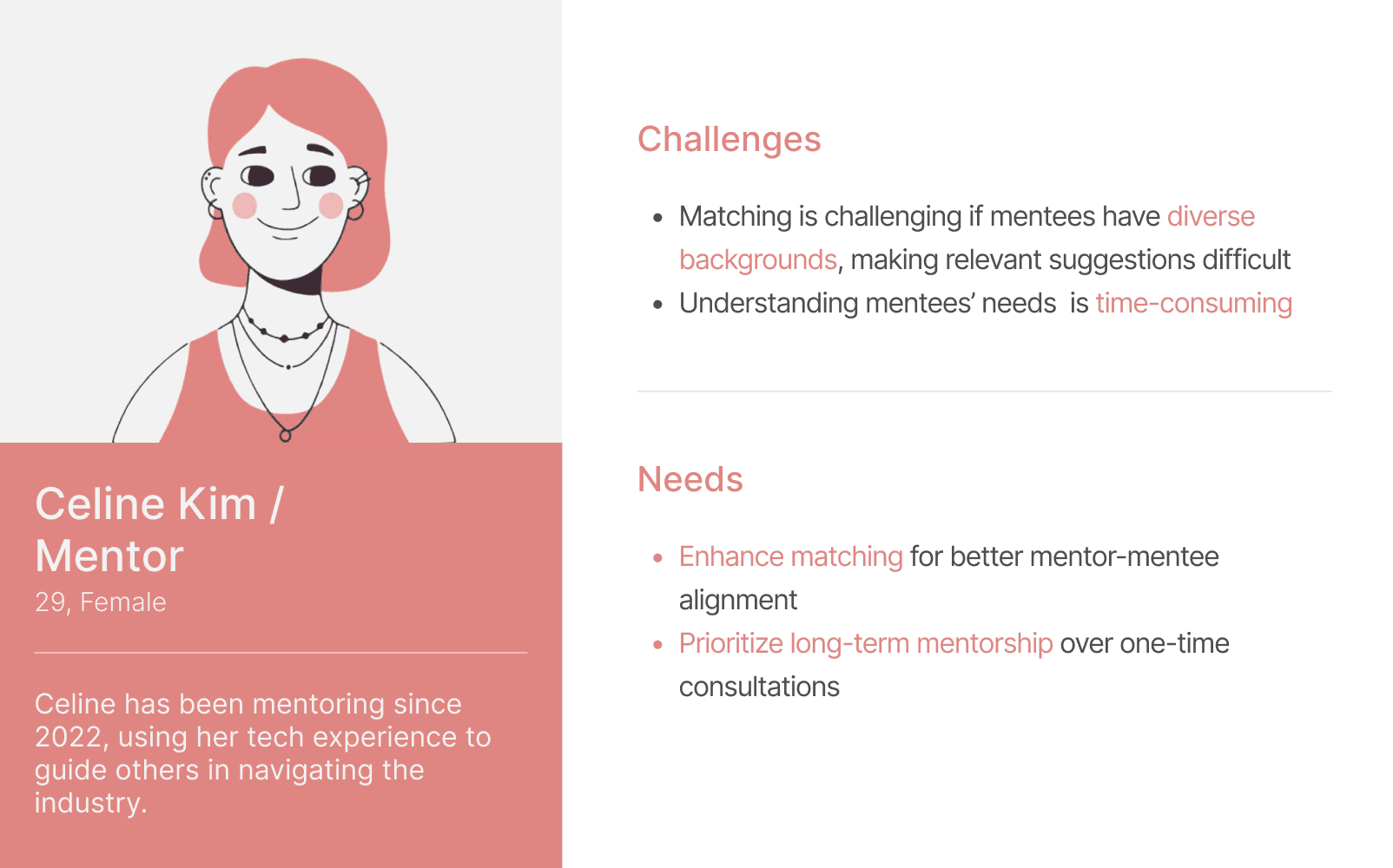
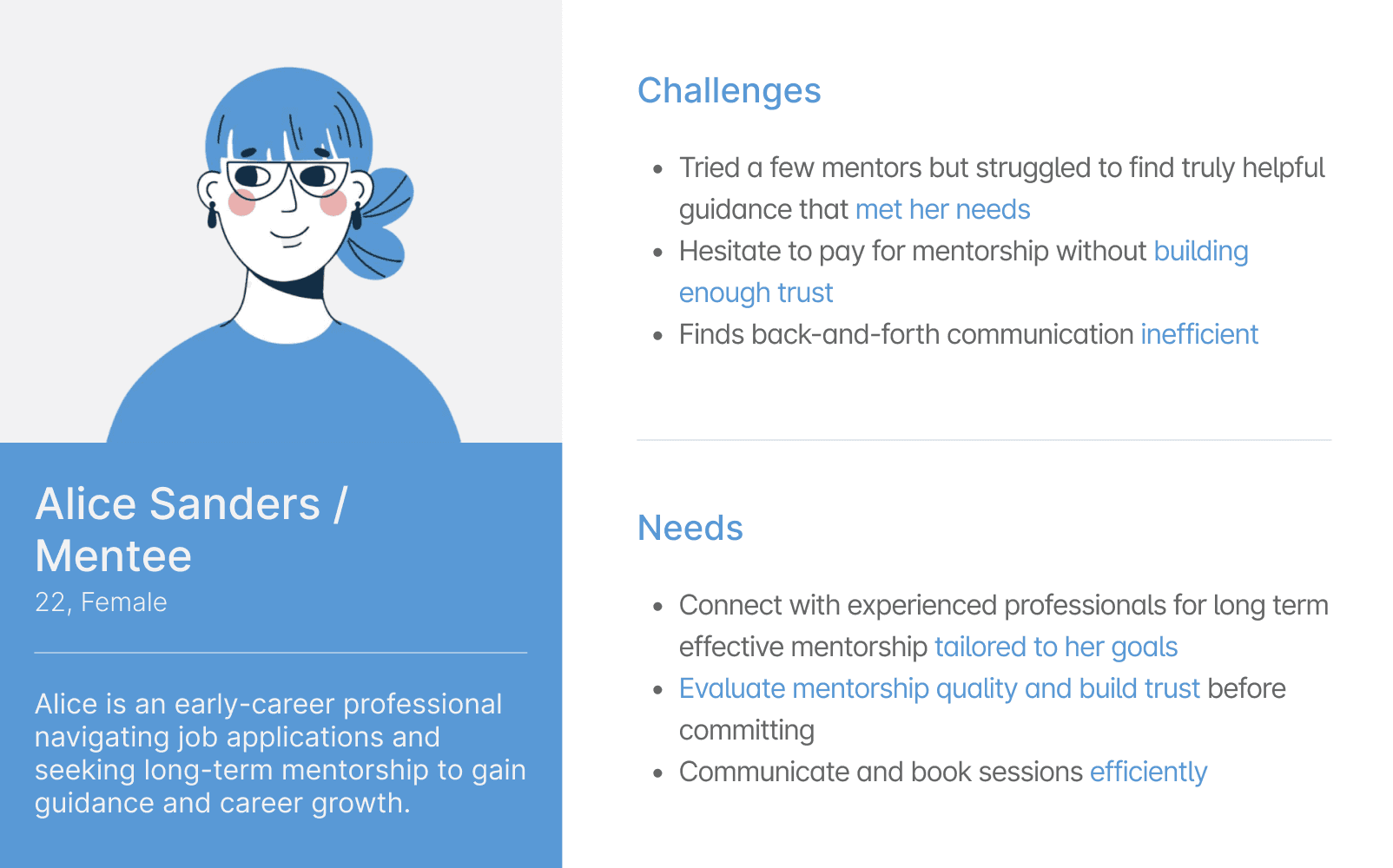
Meeting Alice and Celine
Key Pain Points

Synthesizing the research, here are three key pain points:

🔍

Hard to find right mentors efficiently

🤝

Hard to build trust before payment

️🗓️

Struggle to book efficiently

Brainstorm

Key Features

🔍

AI-powered matching + improved search and filter experience

🤝

Trust-building through social proof and free trial sessions

️🗓️

Centralized dashboard to streamline session management

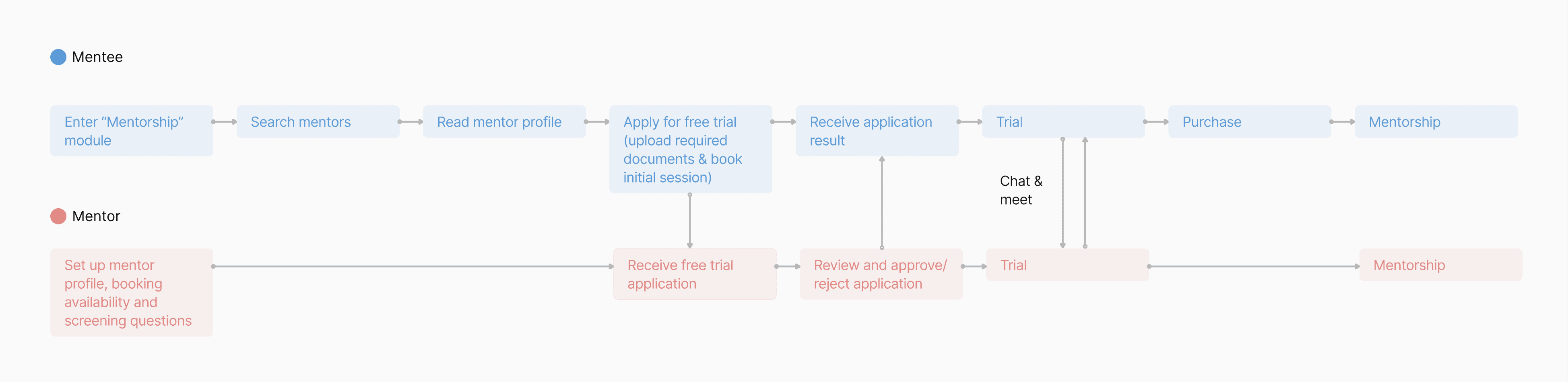
User Flow

Due to time limits, I focus on the journey from discovery to trial

Goal 1

Help mentees discover mentors efficiently

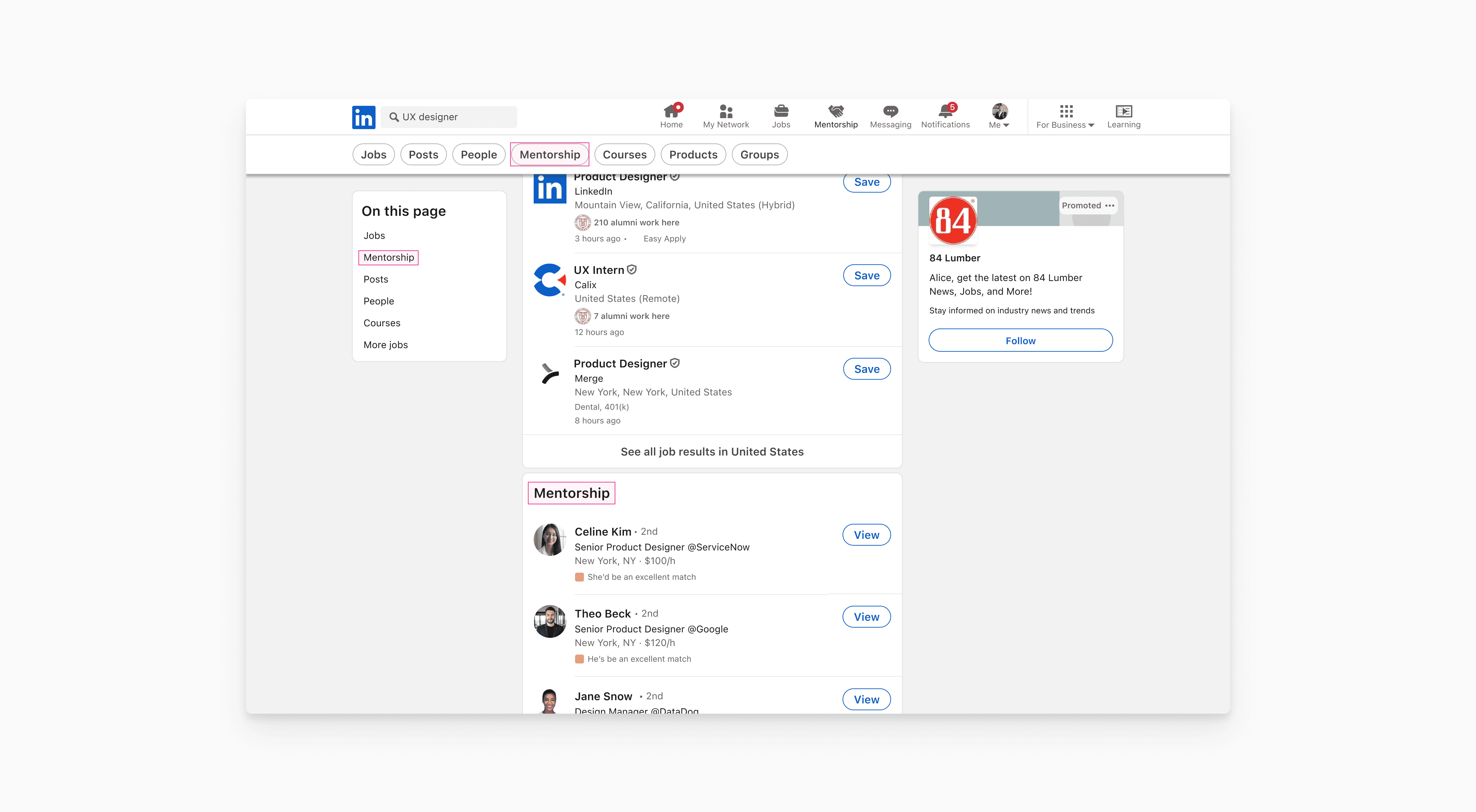
Entry Points

Entry point 1: navigation bar

Adding an entry point to the navigation bar makes the "Mentorship" functionality more prominent, ensuring it is easily discoverable by users. Also, it ensures quicker navigation to "Mentorship" dashboard. After entering "Mentorship" module, users can search for mentors.

Entry point 2: global search

This supports users who may not be aware of the Mentorship module. When they search for other information, they can also discover the mentorship filter. This increases engagement by presenting mentorship as a natural extension of a user's job search or networking behavior, thus enhancing discoverability organically.

Search Result Design

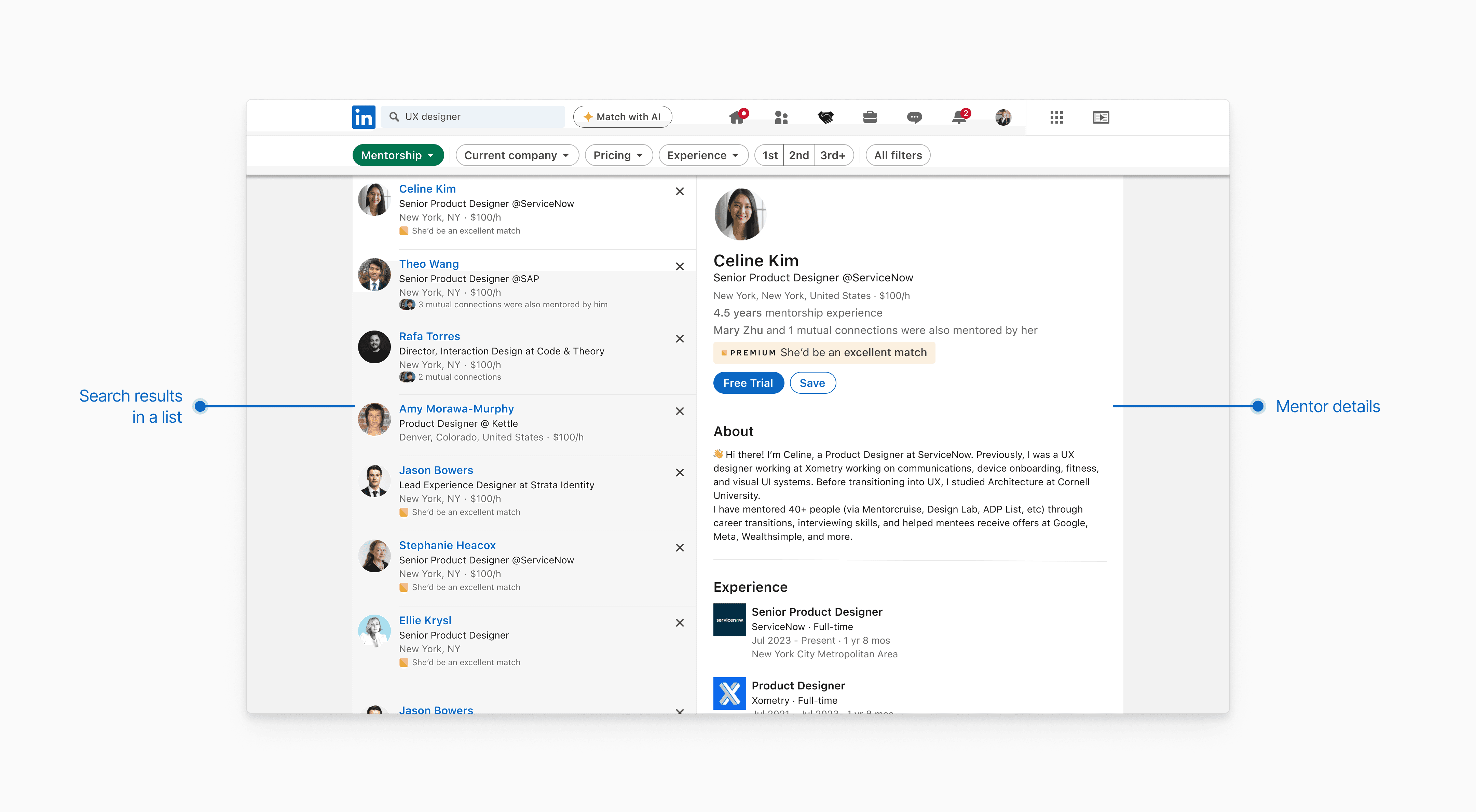
A two-column layout that enables efficient browsing

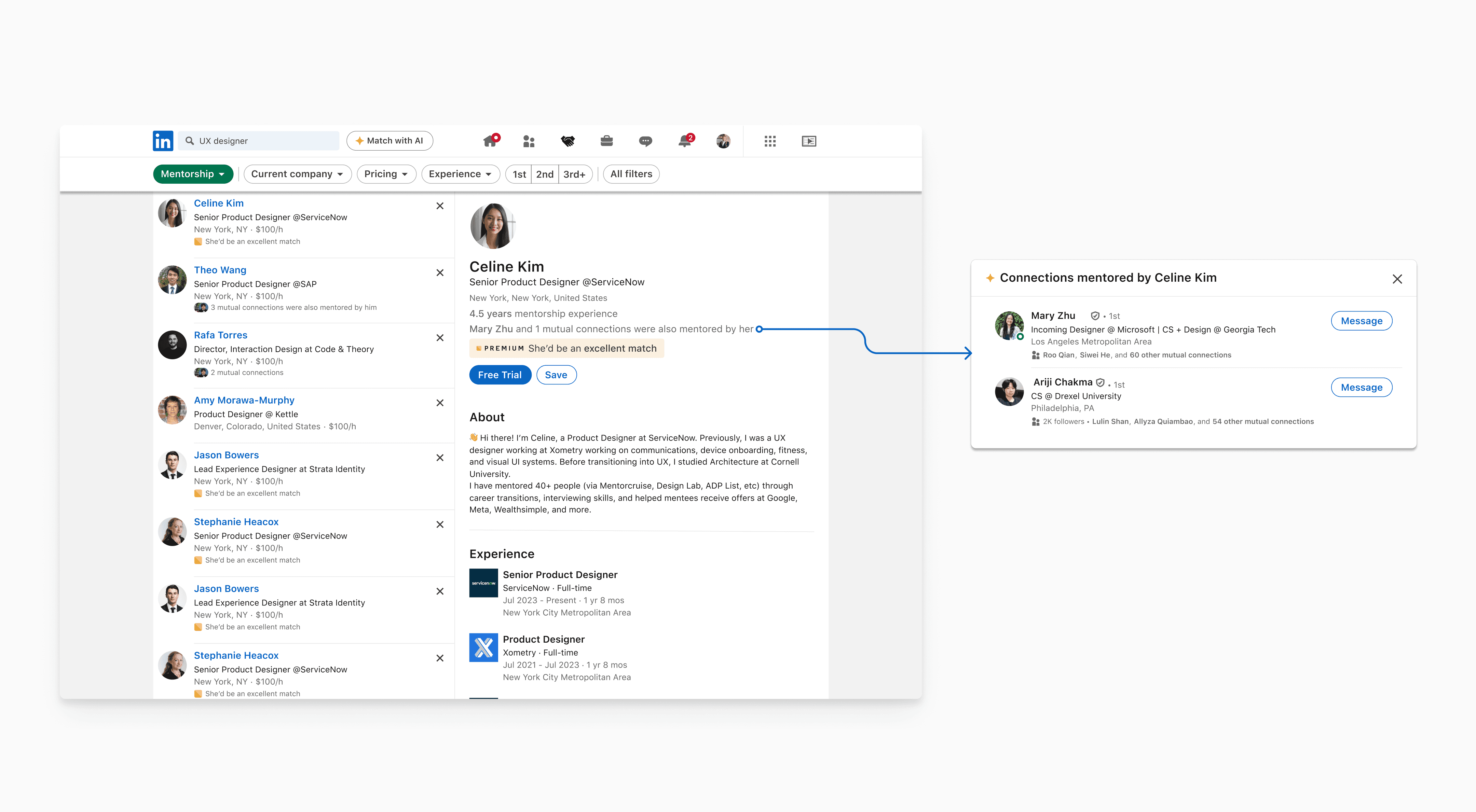
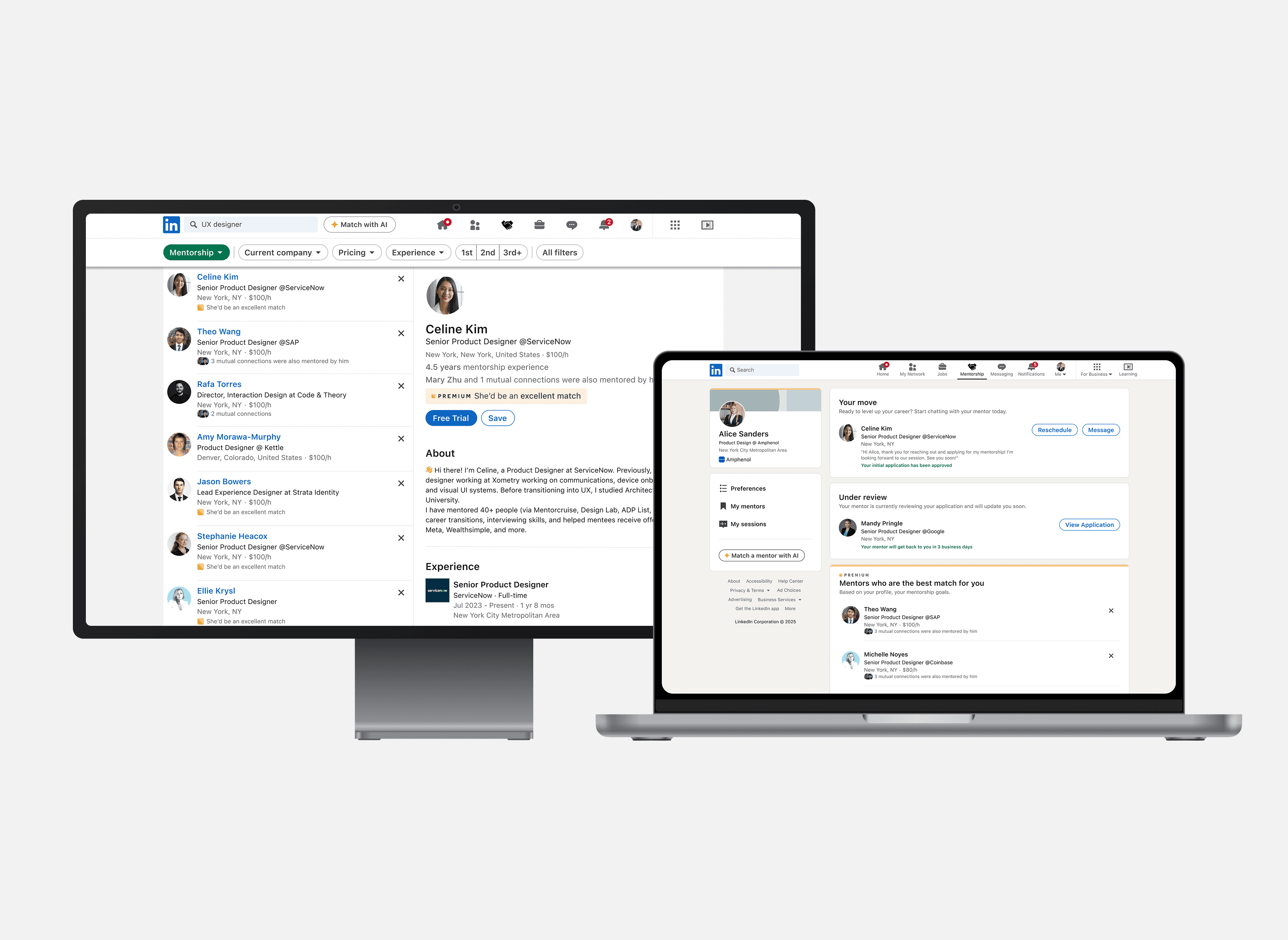
The left column displays search results, while the right shows profile details, allowing users to browse mentors efficiently without opening a new window. This helps mentees quickly scan and narrow down options, reducing the effort of constantly opening and closing profiles.

The left column displays search results, while the right shows profile details, allowing users to browse mentors efficiently without opening a new window. This helps mentees quickly scan and narrow down options, reducing the effort of constantly opening and closing profiles.

The left column displays search results, while the right shows profile details, allowing users to browse mentors efficiently without opening a new window. This helps mentees quickly scan and narrow down options, reducing the effort of constantly opening and closing profiles.

Mentor Detail Design

Determine mentor details through a quick ranking survey

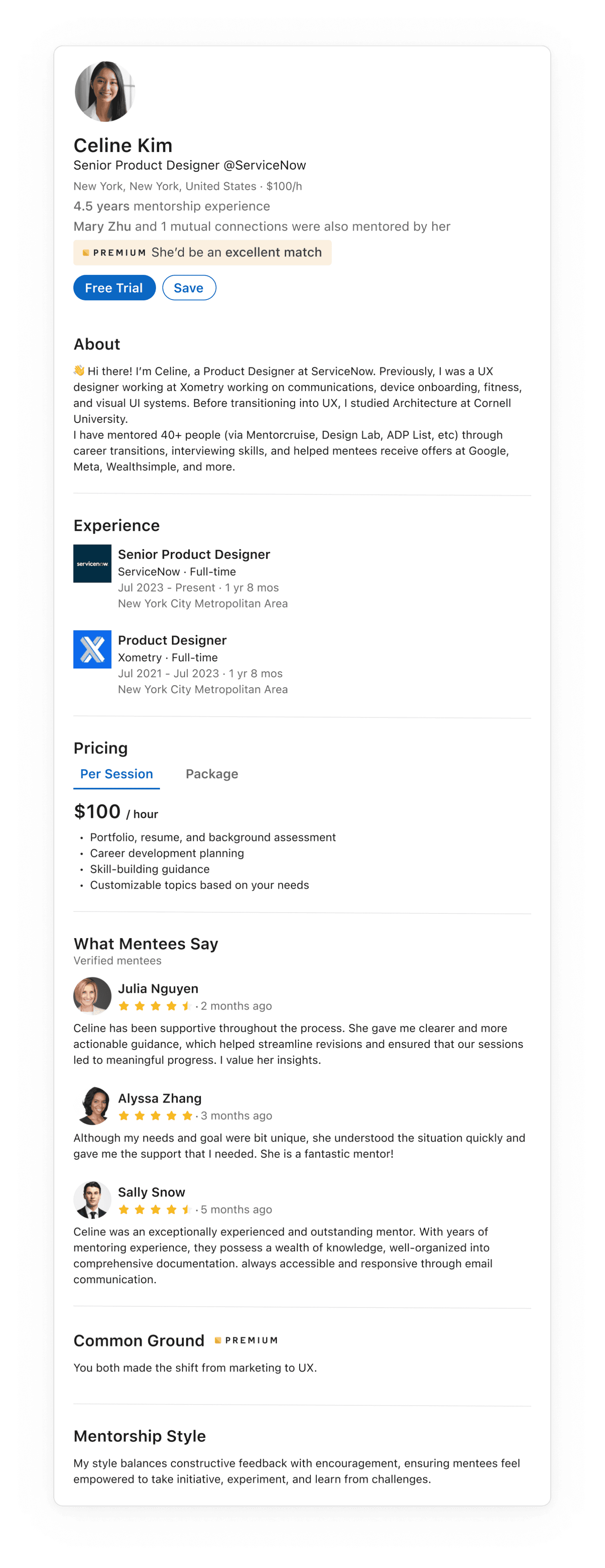
By looking into competitors such as ADPList and MentorCruise, I gained a basic understanding of the information typically included on a mentor profile page. I also discovered that additional details from interviews, such as mentorship style and shared interests, are valuable for decision-making.

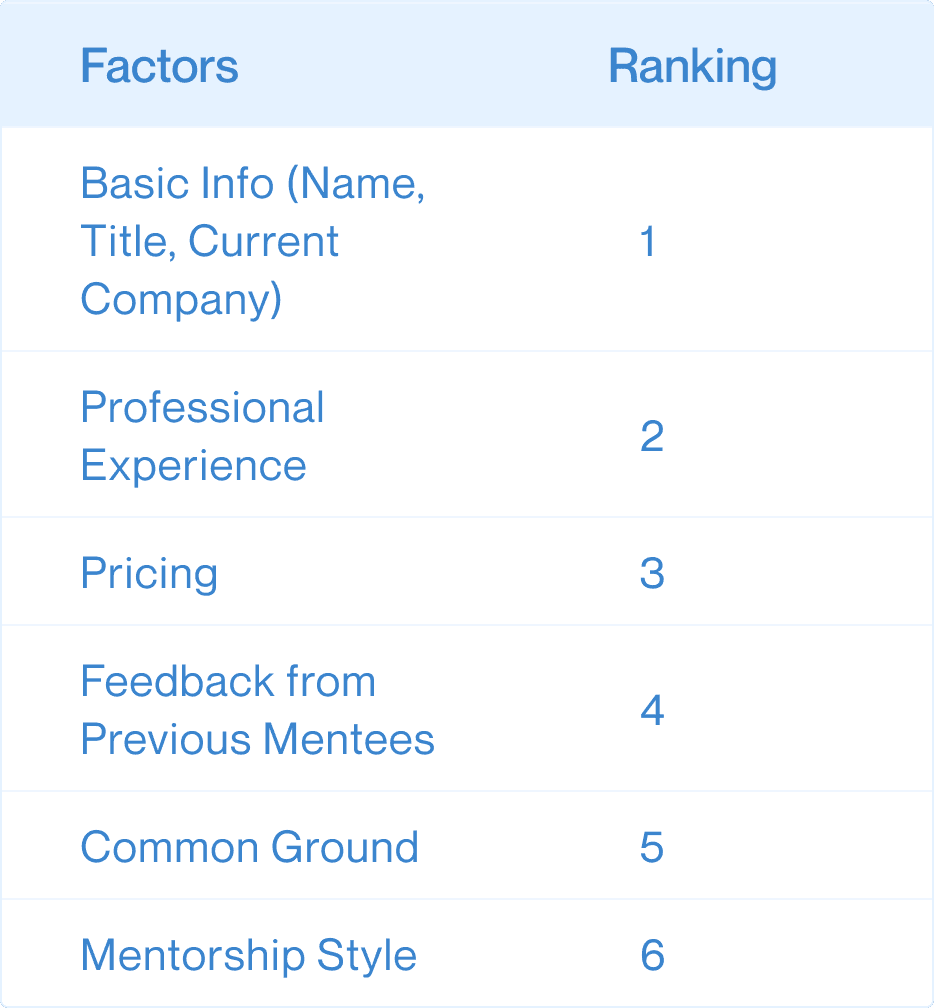
To rank their importance, I conducted a quick survey with 50 mentees, asking them to rank these criteria based on importance. I then incorporated the results into the design of mentor details.

Ranking Survey Result

Mentor details

AI-Powered

Leveraging AI for smarter discovery

👤

👤

For User

More personalized & efficient matching

AI can analyze users’ profiles, experiences, skills, and preferences to recommend matches

AI can analyze users’ profiles, experiences, skills, and preferences to recommend matches

AI can analyze users’ profiles, experiences, skills, and preferences to recommend matches

📈

📈

For LinkedIn

Add value to premium & drive adoption

LinkedIn AI is one of Premium's benefits, and offering AI features can drive user adoption

LinkedIn AI is one of Premium's benefits, and offering AI features can drive user adoption

LinkedIn AI is one of Premium's benefits, and offering AI features can drive user adoption

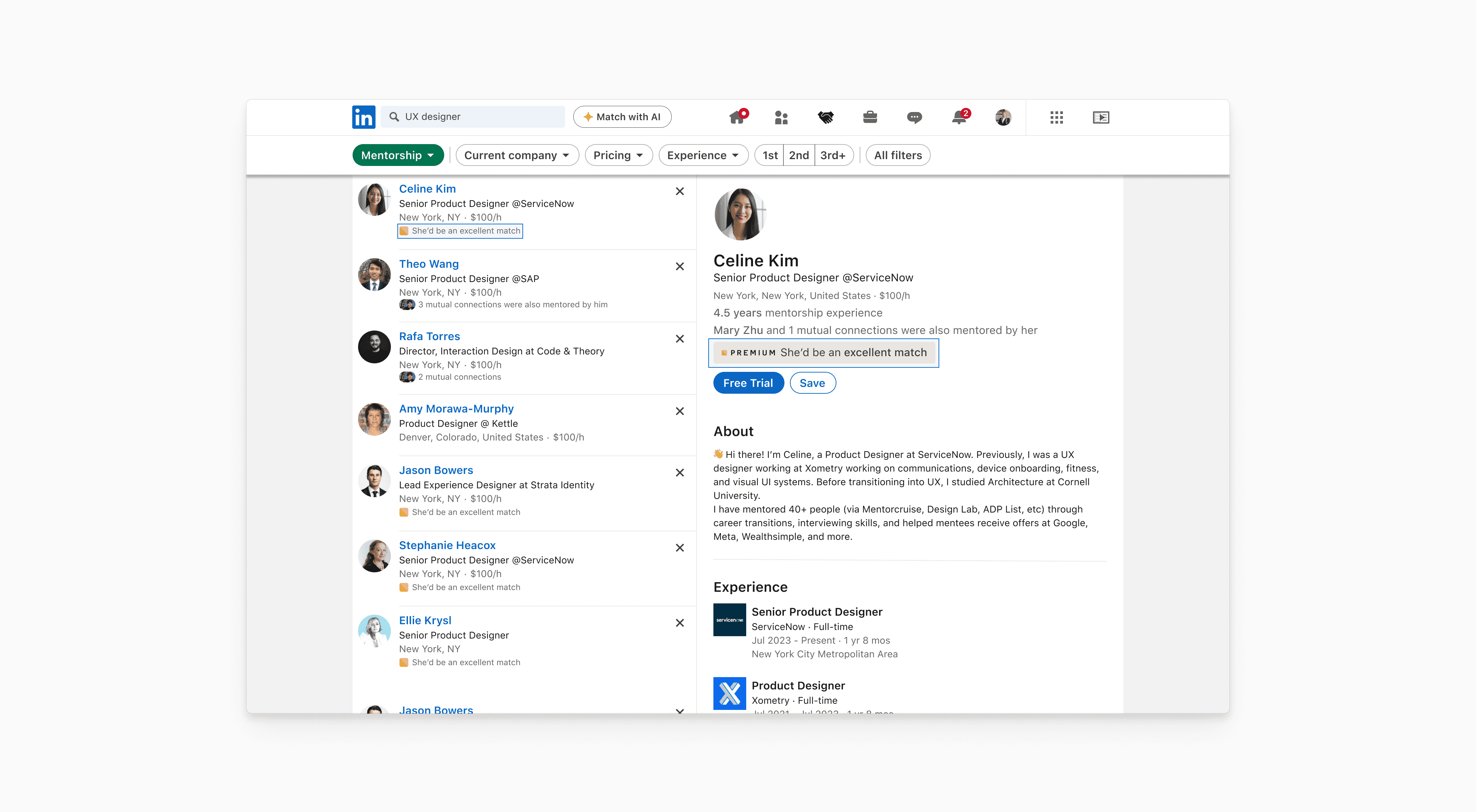
AI-powered matching badges to drive mentorship trial sign-ups

Goal 2

Enhance a reliable connection before payment

Mentorship Network

Create credibility through social proof

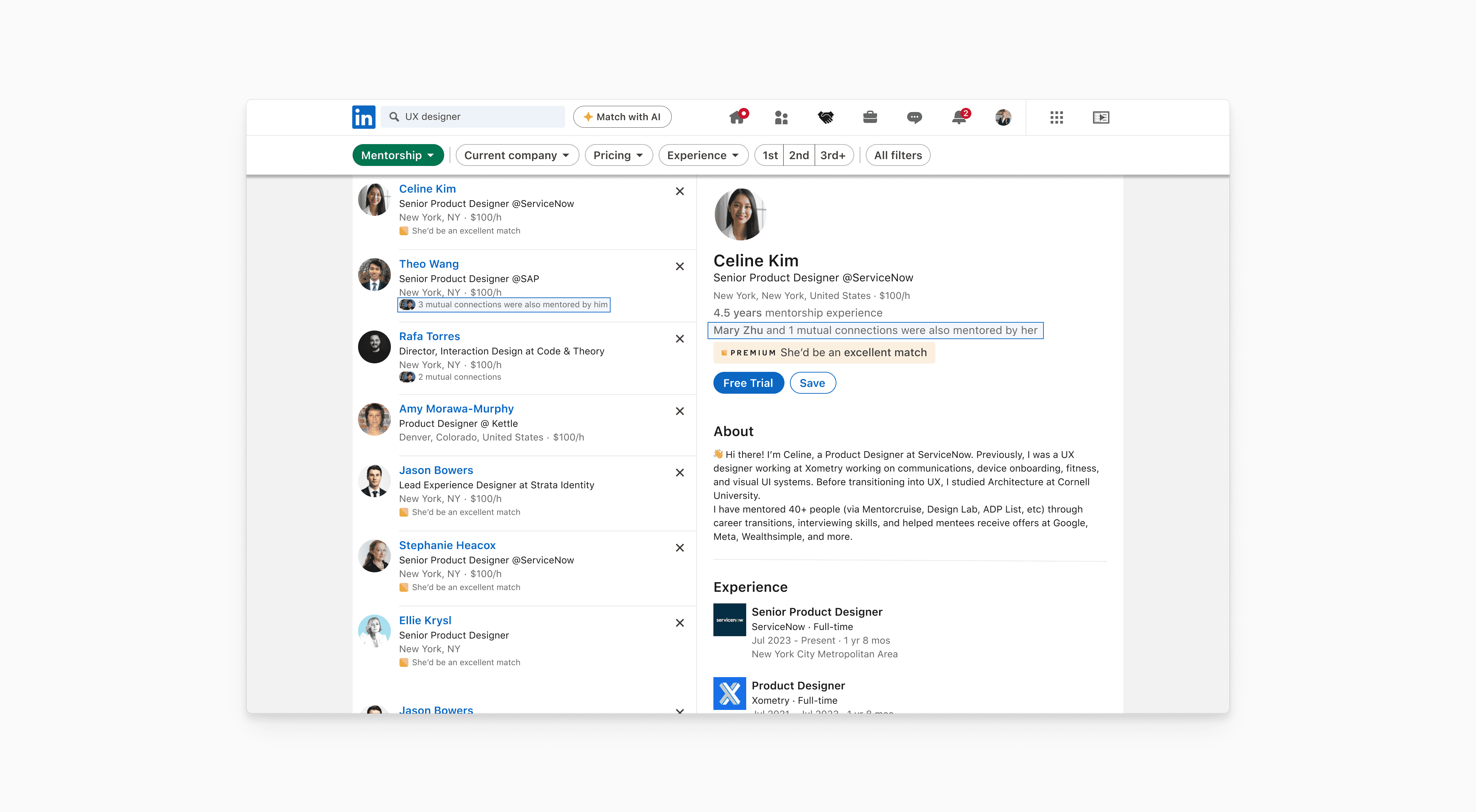
In interviews, mentees mentioned that referrals can help establish mentorship relationships. They want to know whether a mentor has experience working with others from similar backgrounds. To support this, I designed a feature that shows past mentees from your network who have worked with the mentor. This encourages informal reviews and helps build trust.

Show a mentor’s past mentees in your network

Encourage reach out to past mentees to gain insights

Free Trial

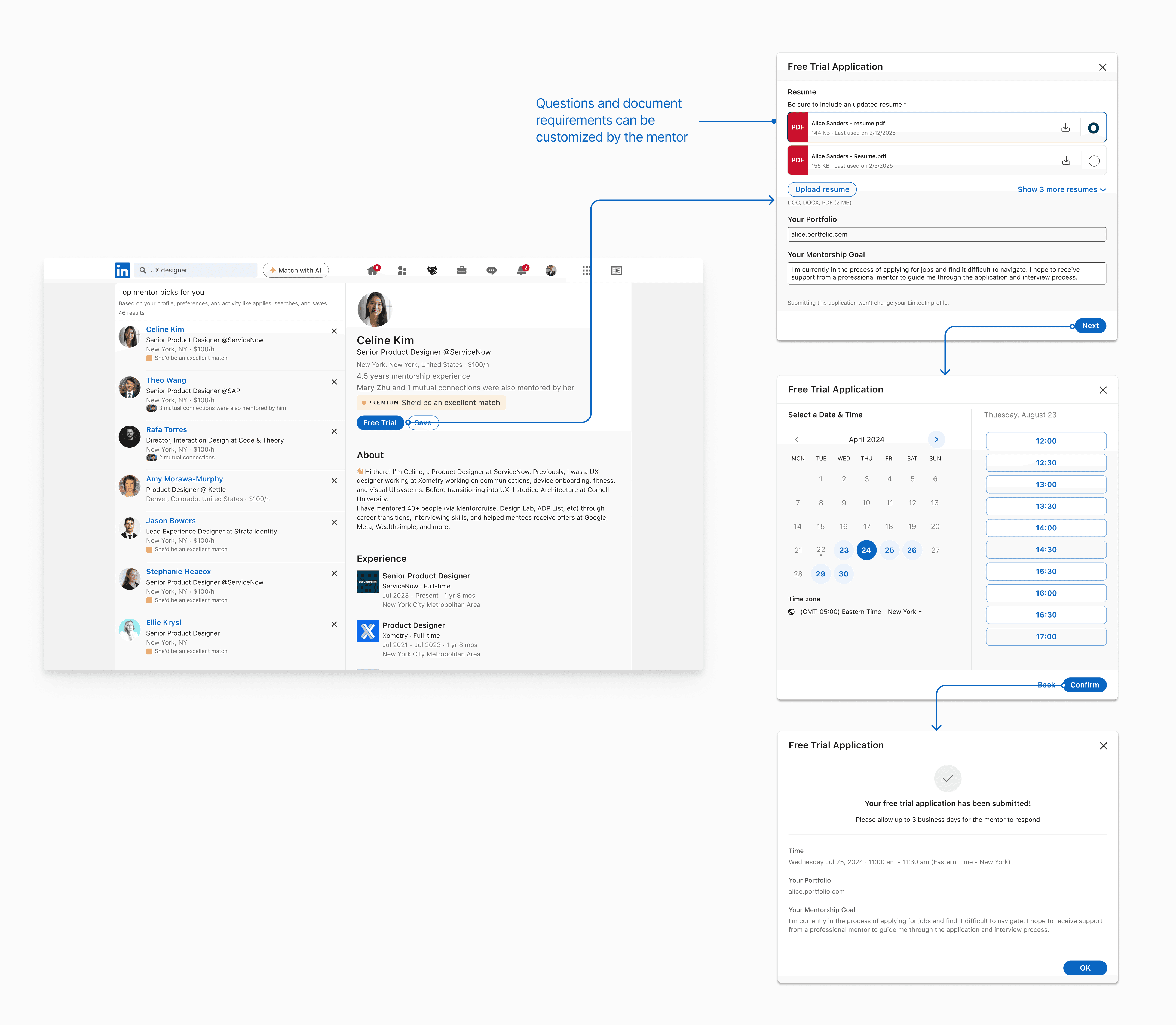
Free trial benefits both mentors and mentees by helping them determine if it’s a good fit

💡

💡

For Mentees

Gain insight into mentors' capabilities and style before committing to a paid plan

📄

📄

For Mentors

Request documents and set up questions to better understand mentees' needs

Free trial flow

Mentorship Network

Create credibility through social proof

In interviews, mentees mentioned that referrals can help establish mentorship relationships. They want to know whether a mentor has experience working with others from similar backgrounds. To support this, I designed a feature that shows past mentees from your network who have worked with the mentor. This encourages informal reviews and helps build trust.

Show a mentor’s past mentees in your network

Encourage reach out to past mentees to gain insights

Goal 3

Manage bookings efficiently

Key Design Decisions

Get mentorship application updates via two channels

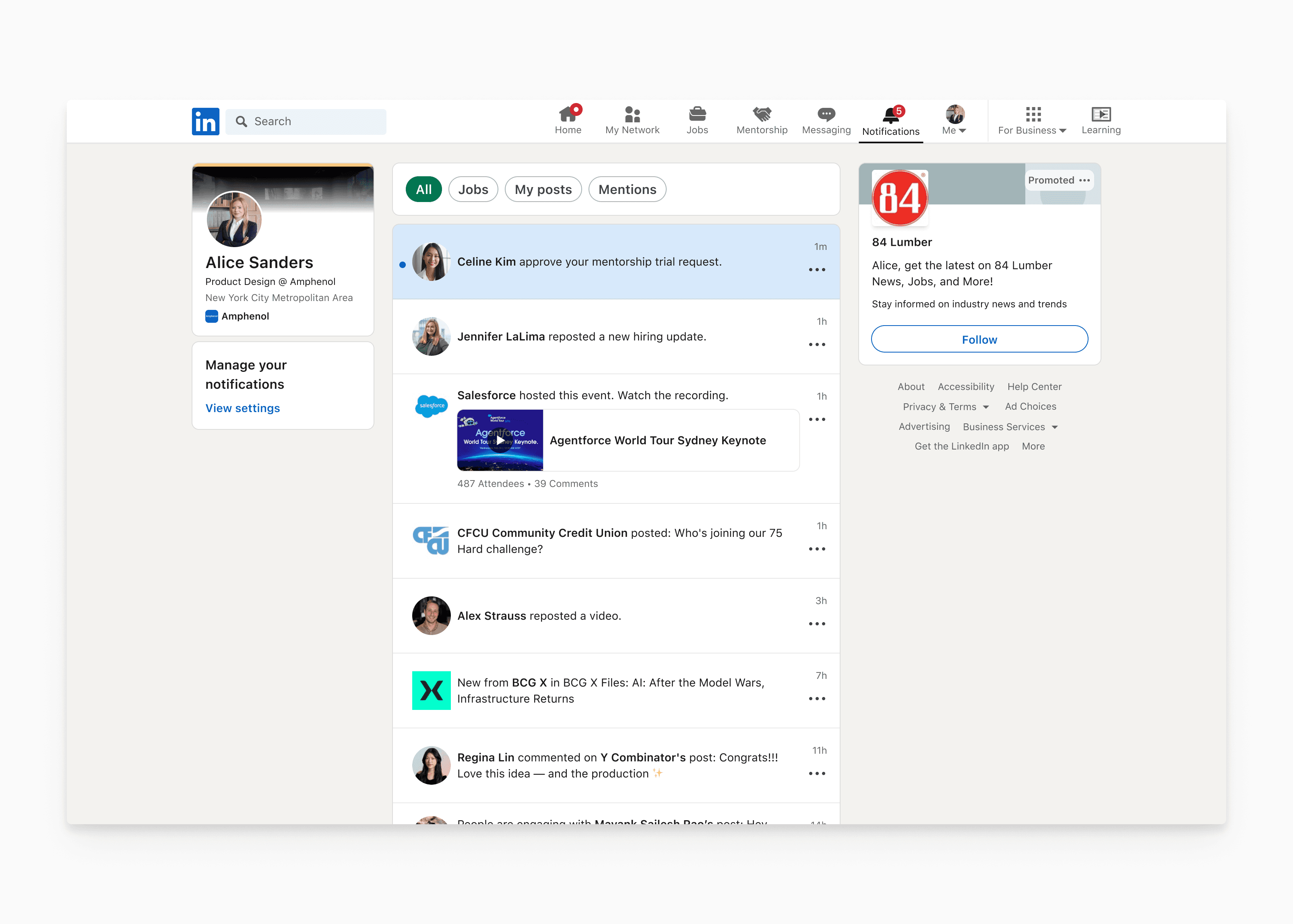
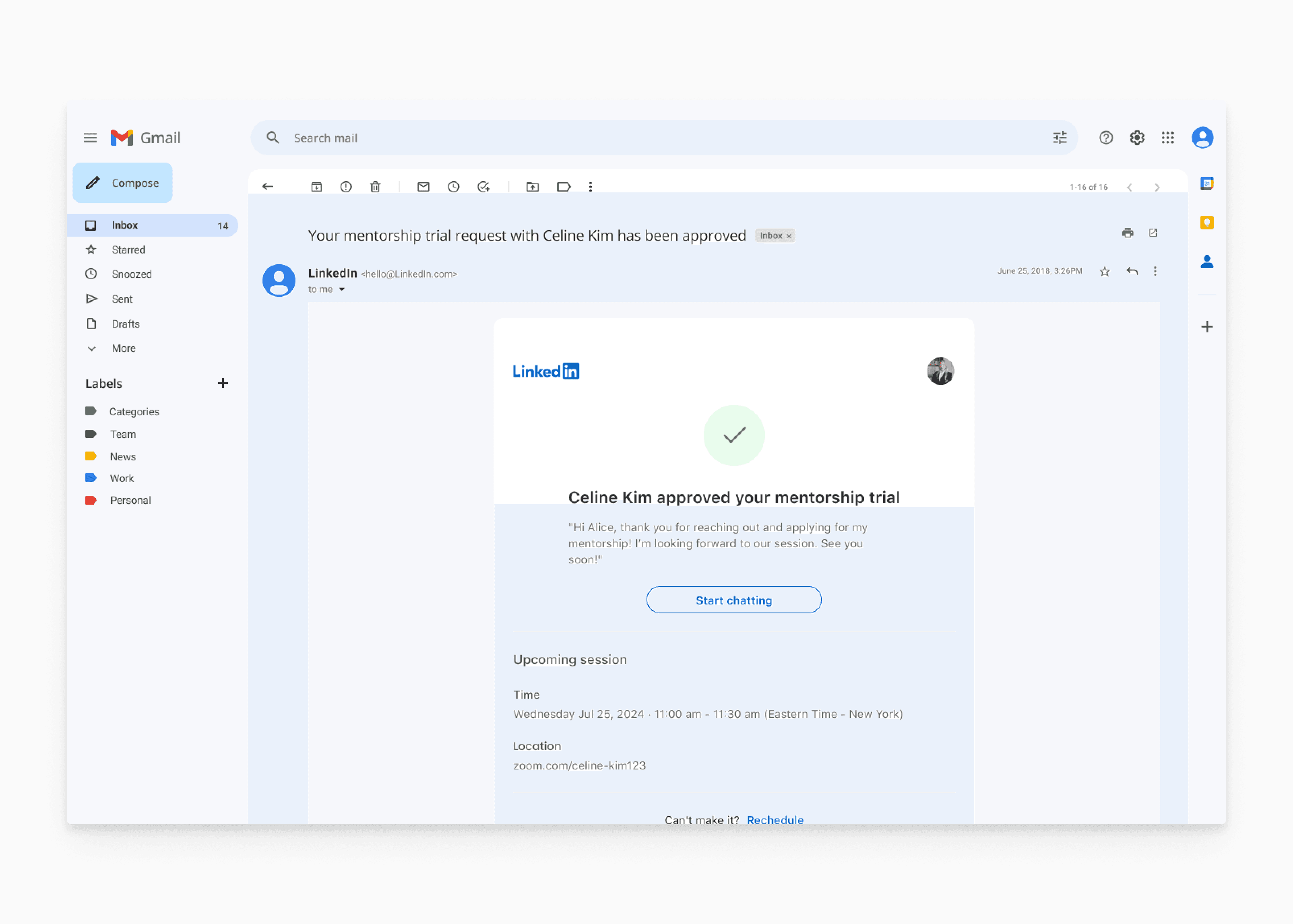
After submitting trial applications, mentors will have five business days to respond to mentees. Email and LinkedIn will be the two touchpoints used to inform mentees of the results.

LinkedIn Notification

Email

Key Design Decisions

Manage mentorship sessions and applications within a centralized dashboard

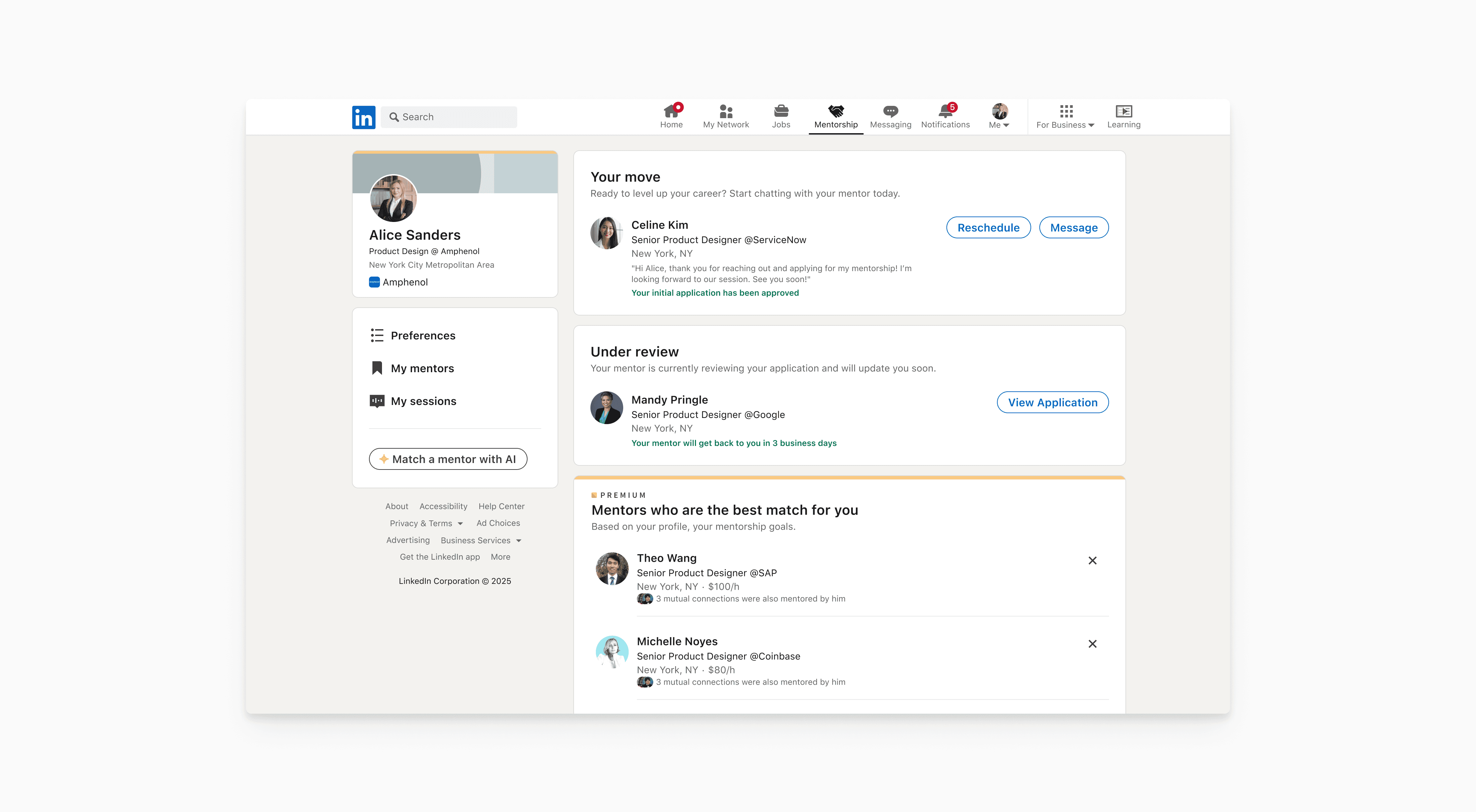
Mentees can track the progress of their trial application, including sessions under review and those already approved. In the "Your Move" section, mentees can reschedule if the proposed time doesn't work and freely message mentors with any questions during the trial period. In the "Under Review" section, to reduce uncertainty, a message is shown: "Your mentor will get back to you within 3 business days.

Next Steps

If I have more time

📊 Test free trial mode and iterate

The free trial mode is designed to encourage mentees to try a mentor and for mentors to use this time to better understand the mentee, giving both sides the opportunity to determine whether it’s a good fit. However, the current trial mode is based on limited user feedback. If I had more time, I would test whether this is an effective approach, whether the 7-day duration is optimal, and explore more efficient ways to facilitate mutual understanding.

👨🏻‍💻 Explore visuals of mentor profile

The mentor profile is text-heavy and contains a lot of important information for decision-making. If I had more time, I would explore ways to enhance readability.